
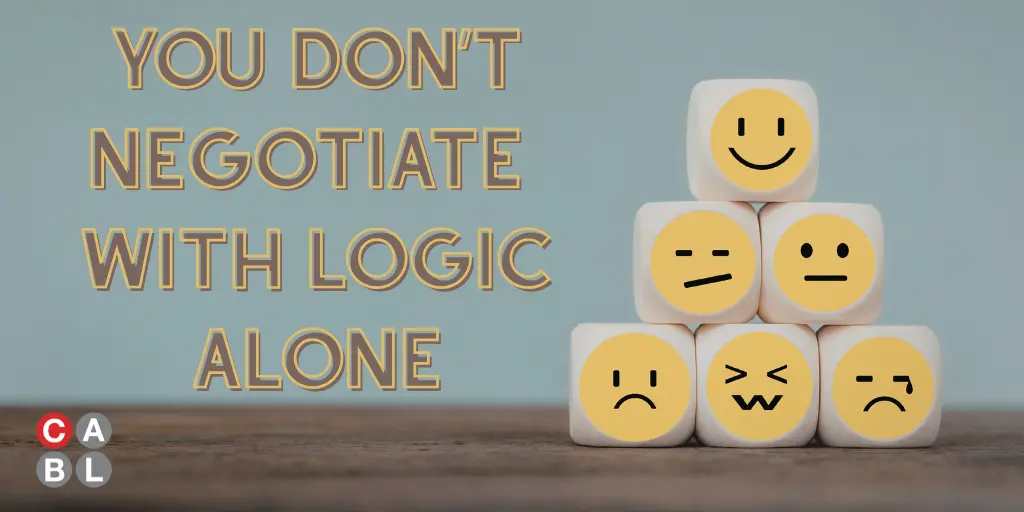
You Don’t Negotiate with Logic Alone: The Strategic Role of Emotions in Negotiation
Negotiation is often described as a rational process, driven by data, objectives, and strategy.
In reality, every negotiation is shaped by emotional dynamics that directly influence how people behave at the table. Emotions affect how information is interpreted, how much we are willing to concede, and the level of trust that develops throughout the process.
Ignoring the emotional dimension does not make negotiation more objective, it simply makes it less conscious.
How emotions enter the negotiation process
Emotions may arise during the negotiation itself, for example, in response to an offer perceived as unfair or to time pressure or they may stem from external factors such as stress or workload. In both cases, the effect is the same: emotions alter decision-making.
Negative emotional states tend to narrow the range of perceived options and increase rigidity. Conversely, a positive emotional climate encourages openness, collaboration, and creative problem-solving. However, no emotion is neutral, excessive enthusiasm can also lead to underestimating risks or alternatives.
Managing your own emotions: practical tips
Effective negotiation starts with self-management. The goal is not to suppress emotions, but to recognize and use them in a functional way.
- Prepare alternatives before the meeting
Having a clear BATNA reduces anxiety and the fear of losing the deal. - Intentionally slow down the pace
Taking a break, shifting topics, or postponing a decision helps prevent impulsive reactions. - Label the emotion
Internally acknowledging “I am feeling frustrated” lowers emotional intensity and increases control. - Separate the person from the problem
Difficult behavior is not necessarily a personal attack, it may reflect strategy or constraints on the other side.
Managing the other party’s emotions
When the other party is emotionally activated, purely logical arguments are often ineffective. Before moving toward solutions, it is necessary to address the emotional climate.
- Listen without interrupting
Allowing space for emotional expression reduces tension. - Acknowledge emotions without judgment
Statements such as “I understand this point is critical for you” validate emotions without implying concessions. - Use open-ended questions
These help shift the conversation from rigid positions to underlying interests.
Emotions, context, and culture
The way emotions are expressed and interpreted varies across cultural and organizational contexts. In some environments, showing emotion signals engagement and transparency; in others, it may be perceived as a lack of control.
The ability to adapt one’s emotional style to the context is therefore an essential negotiation skill.
Conclusion
Negotiation is a deeply human process in which emotions shape decisions, relationships, and outcomes. Those who try to eliminate emotions risk being driven by them unconsciously. Those who learn to recognize and manage them turn emotions into a strategic resource.
Ultimately, successful negotiation is not about being unemotional, but about being emotionally intelligent.
If you want to learn more about this critical skill, don’t miss the next video from CABL Faculty trainer Jordi Quoidbach, where he explores how emotions can be understood, managed, and leveraged to improve negotiation outcomes.